A diary of #anywhereization – working on the iPad with Salesforce1 and various office tools

It wasn’t planned, but necessity made it happen: stuck in extremely busy times working entirely off the iPad (and a mini at that). So what’s all this about mobility, on any device anytime, anywhere? Can we be productive?

Short answer: yes.

Slightly longer answer: read my notes below to understand what worked, how it worked, and what didn’t (at least for me).

By the way, I am sure if I had had the bandwidth to search for solutions/apps when I encountered challenges, it could have been solved. But I didn’t. Simply too busy. So I invented new ways of getting things done.

Day 1

My plan was to stop carrying my laptop when travelling on short business flights for meetings – the iPad mini fits into the handbag and does not even have to come out when passing through security, as it is seen by the scanner as a mobile telephone. So I downloaded Office-To-Go from Nexscience and created my first document during a flight which I could later email to myself, edit and forward/send to the people I wanted to email. Creating a straight forward text was easy and intuitive and it did not reformat when moved between applications.

Getting back to the office,  my laptop – died. No time wasted, turned to Chatter on the Salesforce1 platform on my iPad to update my co-workers on the project in the appropriate Chatter group. It saved me having to write meeting notes! In fact, I could share more information more directly – because you get lazy when you have to type it all on the small iPad mini keyboard. Within 20 minutes, all the details discussed in the meeting were shared with those co-workers working on the project who would then be alerted to them in their Chatter feed.

  • Less is more – direct messages in a collaboration tool gets the information directly to your co-worker who does not have to open yet another document and read through a lot of prose. And can respond right there in the same  feed for everyone else to see. No “reply-all” –  it’s a need-to-know only solution
  • Productivity indicator – saved 30 minutes – no need to organise your notes to  write a structured report. And immediate sharing, instead of another dreaded set of meeting notes lying around that need to be written “when you have a moment”.
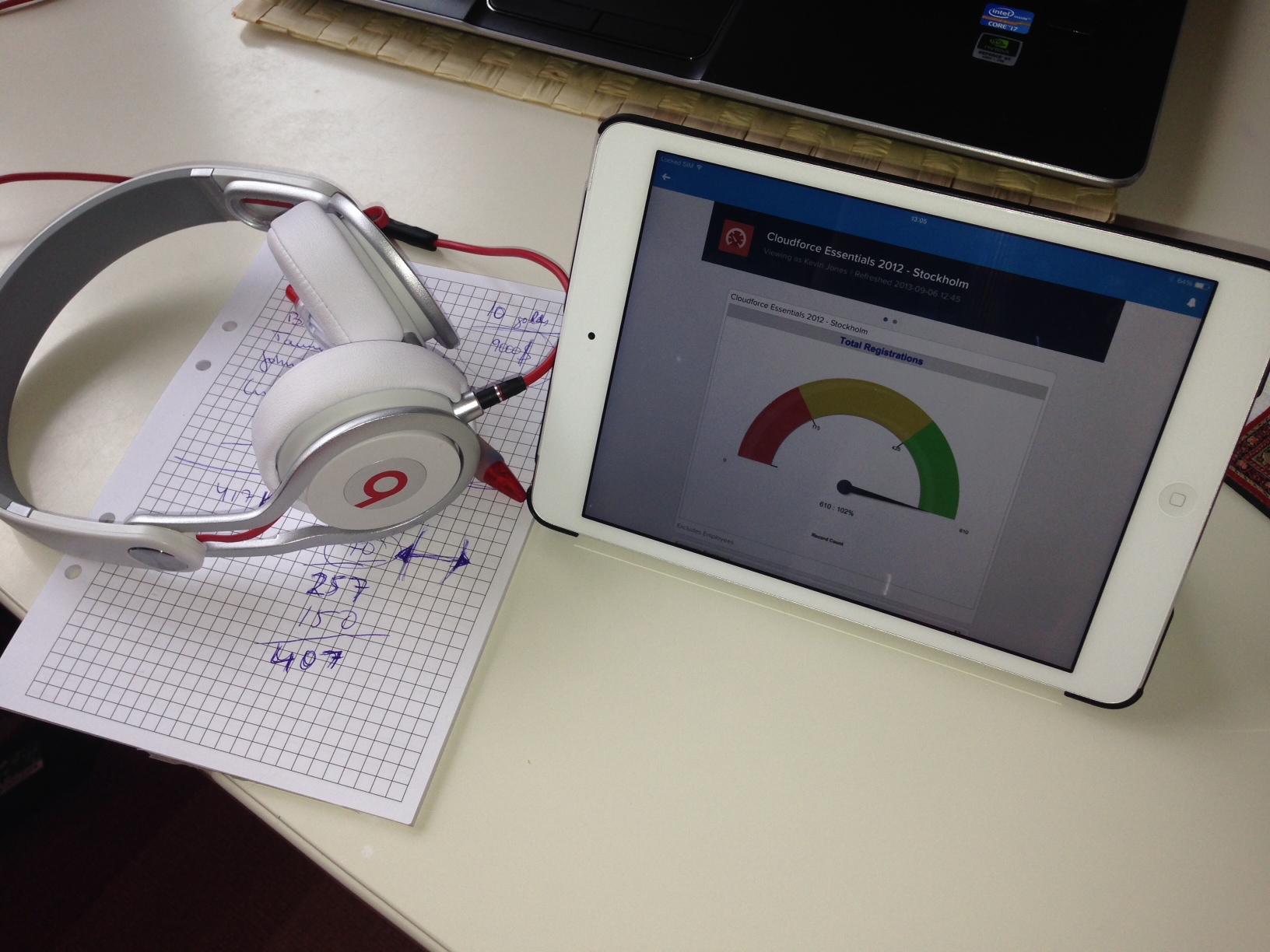
Running your business from an iPad

Running your business from an iPad

And then I logged a ticket with our IT hotline – also in Chatter – to get help fixing the laptop. Obviously, as I could not log it from the laptop. Duh… Considering I work offsite (#anywhereization) and it being a hardware issue, I braced myself to be stuck with the iPad for at least another day.

Day 2

Opening emails as the first thing you do makes little sense if most of the interaction you have is in the Chatter feed – including just getting an overview of what happened overnight in a global company that never sleeps.

Working on the iPad mini means you can work everywhere, so why not right there with coffee and a toast without even getting up – and it is not nearly as uncomfortably hot as a laptop on your knees. Who hasn’t had a “laptop-burn” on their thigh at some point – or fried a battery charger under the covers.

  • You end up working in the most awkward positions.
  • Productivity indicator  – Down at least 60 minutes, as I should have been up and in the office instead.

In preparation of a new project briefing to be kicked off in a conference call later that day, I had planned to create a fabulous Powerpoint slide deck with nice images, amazing graphics and charts. But that was not an option with just your index finger and an iPad mini screen size. So I opened Keynote which I knew was a cool app. But since I am not a Mac-User (yes, my laptop is in fact a PC) I never checked it out. Now was the time. It took some trial and error, and I never figured out how to import the cool graphics and charts and nice images. But all the information needed for the briefing suddenly fit into 5 slides – just text and itemized lists and links to other sources of information. No fancy stuff that is nice to look at but not really carrying any information.

  • Keeping it simple also gets the information out.
  • Productivity Indicator – Saved 60 minutes of searching for the perfect graphic, the perfect photograph, creating the perfect pie chart and reformatting into the perfect colour scheme.

But what about the conference call? We mostly use GoToMeeting so that was a fast and free option to download to the iPad and then log into my existing userID. But I never figured out how to schedule a meeting for later, so had to open one in meet now and then let it beep in my ear until the meeting started 20 mins later. I experimented to be sure it all worked once the co-workers were joining to save everyone the frustration of a failed conference call, but it meant I had to live with the beep. Honestly, folks at GoToMeeting, could you not give us some music, instead? The beep eats my brain cells. I had sent everyone on the call my fantastic Keynote presentation with only 5 slides for them to read, which was greatly appreciated – so it all started off on a really nice note and we had the most agreeable session where everyone agreed, and we agreed on who should make it happen:  me – but that’s another blog, I fear.

  • Learn how to SCHEDULE a GoToMeeting on the iPad as soon as you can to avoid the beep.
  • Productivity Indicator – saved 30 minutes, as everyone had the clear, short itemized briefing and we did not share any slides on the call to go through in presentation mode where everyone wants to comment (at least in Sweden) and knocks you off track. No questions asked = agreement was quicker and based on the facts only.

Day 3

Laptop fixed, off into the office to plug it into the docking station…. and it died again. Motherboard fried. Back to the iPad. My eyes were swimming – also because the iPad mini screen is so small that it is really tiresome to work for 8 hours squinting like that.

By now, I found myself checking Salesforce1 notifications continuously rather than checking emails – it is just quicker to get the issue/request sorted within the app, so that any links to information that is already part of Salesforce is there without having to copy/paste it into an email. As a matter of fact, I find copy/paste very difficult to execute on the iPad – maybe my fingers are not the right size.

All is not well  when you really need to get your head down to business, though. When a process is not designed intuitively for the mobile interface, some things just cannot be done. Such as updating Google Docs. Painfully, I realised that I had to start writing apologetic Chatter posts to my co-workers that dealt with the more logistical aspects of our ongoing projects – you know, budgets and stuff. The beauty is, that the apology posted on one co-worker’s Chatter feed actually resulted in two others reading this post and offering to help with completing all the steps that I cannot currently take care of from the iPad. So – in fact – I did not ask for help, but help was offered. And saved me the humiliation of casting the towel and delaying the process impacting everyone in the chain of events. Running complicated projects on a tight timeline requires a well oiled machine where every link is the strongest link. And I am the weakest  link when unable to complete my own tasks.

  • Until all business processes are intuitive and integrated in  the mobile interface – not just VIEW but also CREATION, you need friends when stuck on the iPad.
  • ProductivityIndicator –  Lost at least one full day in the progress of the project. Not a good thing.

Day 4

Waiting for my replacement laptop got me another day on the experiment – and made me realise that a big screen is probably a better choice when I need to write more than just a few brief messages. So I ended up working in a hybrid – and perhaps a little less smart – but hey, it worked.

You just need a bigger screen, sometimes

You just need a bigger screen, sometimes

My private laptop is big – really big. I use it for playing computer games. You need a big screen to find all those monsters in the dark. Today, I created long documents (including this blog) on this fantastic device with a proper keyboard and ergonomic mouse – and emailed them to my company email to process on the iPad either as another email now going where it was supposed to go, or as a briefing/post in Chatter. It’s backwards, but at least my eyes are not swimming. And easier to make sure there are no typos – or unintentional bloopers – in the information that I share.

  • You are physically challenged if you work intensively and long hours on an iPad – need more meetings or other  non-computerrelated activities to break the spell
  • ProductivityIndicator  – Minus 50% productivity on the day, having to send documents back and forth between devices and formats requiring reformating/editing.

Looking forward to my laptop tomorrow, you are still my best friend. But iPad Mini – you saved me and will always remain close to my heart. Or in my handbag.

Please excuse any typos – as this was proof read on an iPad Mini.
Affärshantering i molnet – så tänker vi (post in Swedish)

Hur öppen, flexibel och användbar är din plattform? Hur ofta behöver du uppgradera dina affärssystem, och när det väl händer: är det synkroniserat så att alla är uppe och på samma version på samma tid? Diskuterar ni Cloud teknologi vid fikabordet?

Utvecklas dina lösningar till mobila devices, eller måste du vrida på surfplattan för att få med hela interfacet, eftersom det var byggd för en datorskärm?

Kan du uppdatera dina kundmöten, godkänna fakturor, bygga workflows medan du springer över gatan mitt i Stockhkolms-trafiken? På din mobil?

Det är så man tänker på salesforce.com när man utvecklar lösningar för affärshantering i molnet. Det var Cloud Computing som gjorde det möjligt, men det är vi som får det att hända. Du och jag.

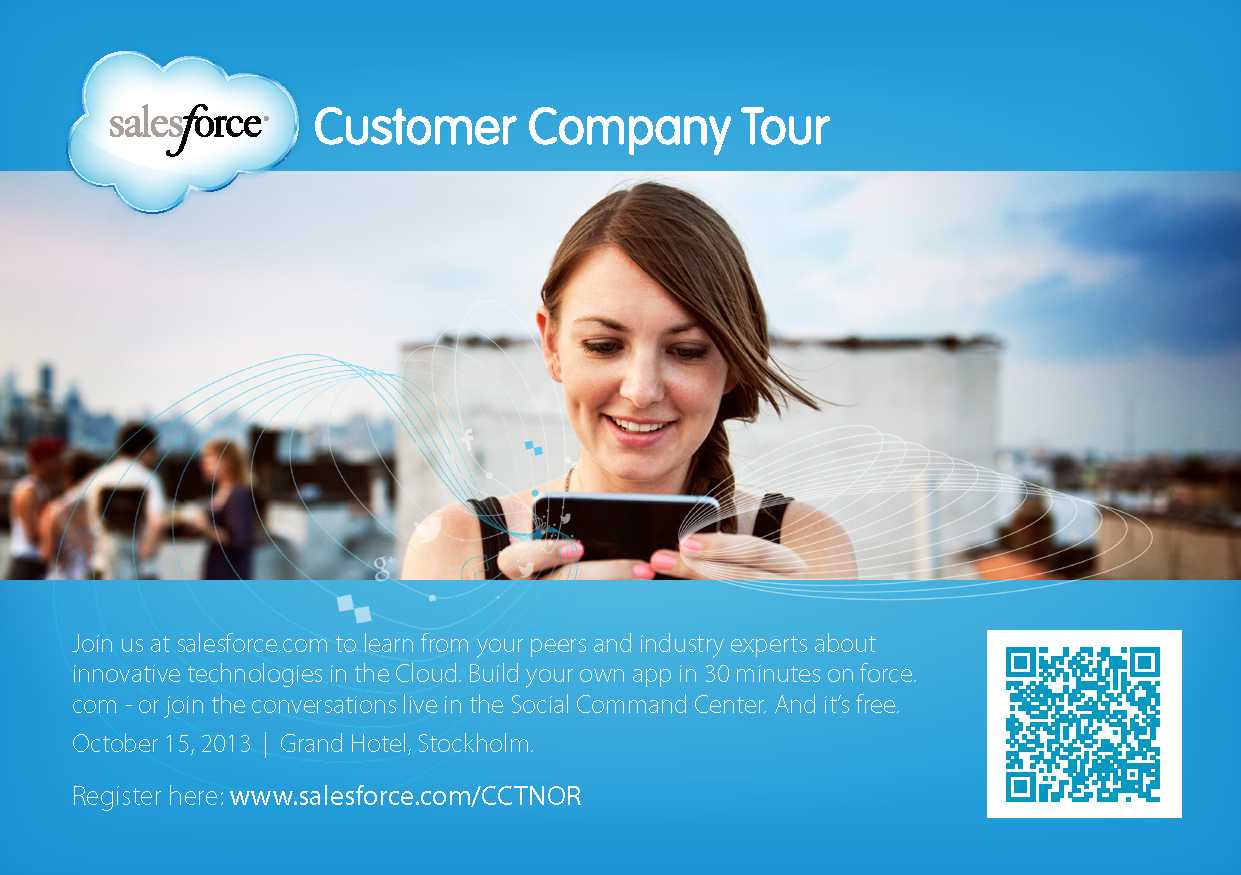
Om man verkligen vill förstå hur allt detta spelar ihop – hur teknologin används för marknad med smarta verktyg byggd i och för social, som säljverktyg och som connected kundservice – då kommer salesforce.com faktisk att bjuda på gratis inspiration. Den 15 oktober på Grand Hotel i Stockholm hålls Customer Company Tour Nordics – en gratisk heldagskonferens (på engelska) med runt 30 utställare och keynote och eftermiddagssessioner där kunder berättar om hur de använder teknologin, hur de skapar nya  verktyg eller bygger egna appar på force.com plattformen, och helt enkelt har mera kul.

Image

Huvudtalare är Erik Hallberg, VD för TeliaSonera International Carrier som bygger sin IT arkitektur på force.com plattformen och använder Salesforce både som internt collaborationsverktyg, i sälj, marknad och kundservice. Och Line Dahle från norska marinförsäkringsbolaget Gard AS – ett 120 år gammalt traditionellt företag som nu jobbar i molnet med kommunikation, intern kollaboration och hantering av ärenden och kundservice. För speciellt i den branschen måste man kunna respondera snabbt när det smäller till på ett skepp någonstans ute i världen.

Dessutom kommer det finnas demo stations, så att man kan testa själv eller få en av salesforce.com’s egna utvecklare visa. Och session som omhandlar allt från hur President Obama vann valet med hjälp av Salesforce och sociala medier till hur stora företag flytter hela sin verksamhet till en mobil, öppen, social plattform för att möta kunden där kunden är.

Du kan registrera dig här – det är gratis.

The ROI of Social Media – or how to convince your boss

Social Media is engagement – if you don’t get it yet, I hope you will very soon. But engagement is very hard to measure, so even if you do get it, your boss might not appreciate the value of your efforts.

That is why you need to create a social media engagement strategy around metrics and value add = ROI. You need to have a conversation.

The traditional way of counting is through “fluffy” things like Facebook Fans/Likes or number of retweets – which I think is just a natural extension of marketing’s best friend: click-through rate on email blasts. It’s hard to leave your comfort zone, even if you are an innovative marketer who really wants to embrace social.

What does it cost you, if you do NOT have a social media engagement strategy?  Here is a link to a free eBook with some good statistics and methods.

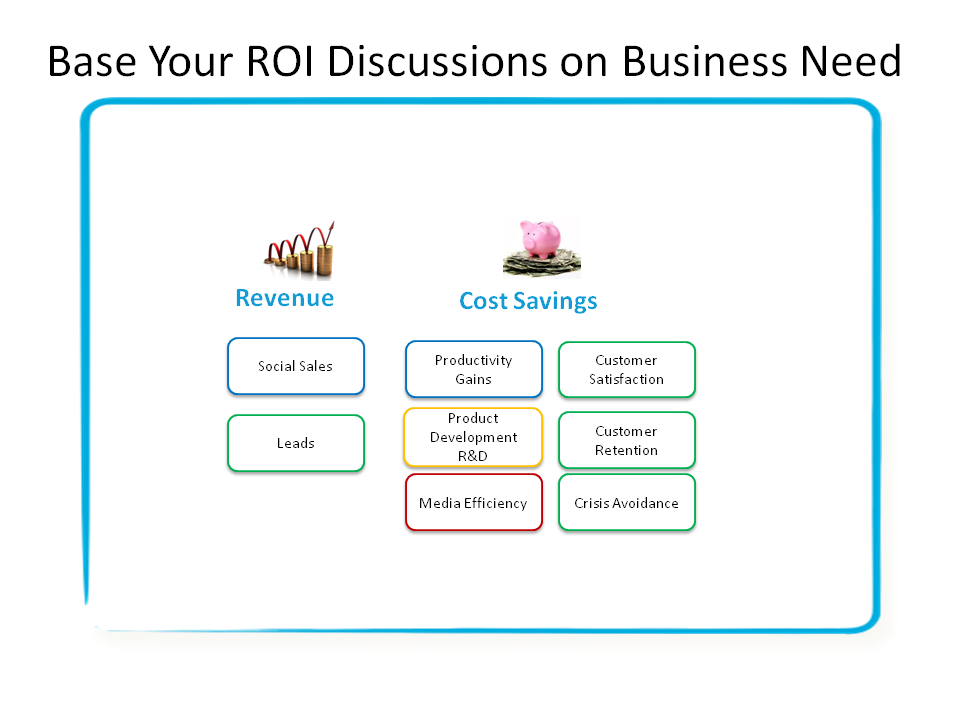
At Sweden Social Web Camp (SSWC)) on Tjärö island in August, we tried to look at ROI benefits versus costs. What it boils down to, is tangible, measurable and very convincing:

Source: Salesforce.com

Email marketing on its own is not engagement. And it’s getting harder and harder to use on a large scale.  Let’s talk instead.

Soft and Hard: Facts & Figures

Finally, here is a link to all the slides I presented at SSWC – there are some wonderful charts and hard numbers from salesforce.com’s extensive customer research. You can use them in your own context. Or  take them to your superiors to get at least as much – if not more – budget for your social media engagement as your colleagues in traditional email marketing.

Being social – it’s B2B, it’s B2C, it’s everywhere

There’s really no excuse – go where your customers are and engage: become a customer company. If you do, the benefits will be extensive – increased customer satisfaction, keeping tabs on the competition, marketing your latest product that could go viral, a more productive and efficient mobile sales force. Below are some great examples of Do’s and Don’ts.

To get inspired, I attend the Sweden Social Web Camp on the provincial island of Tjärö every year, to understand what goes on in the creative minds of those dominating the social media scene. It’s worth visiting their website to understand what social means in terms of branding, collaboration, and innovation.

Before I’ll give you my tips on how to create a social media strategy, let’s take a look at your toolbox:

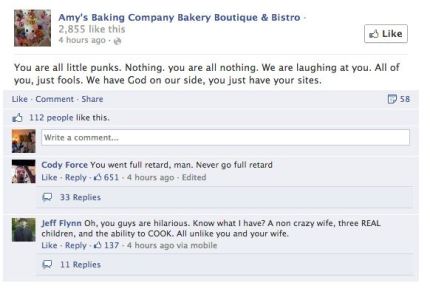
Facebook: On Facebook you can reach consumers of all demographics and it is a powerful and effective tool with all of its 500 million users globally. When your business profile is up and running and Facebook users become fans of your page, they get automatic newsfeeds or other updates from your company. Facebook is also a great multiplier because you will reach the network of your fans and their networks.  But be aware – things can go wrong: One horrific example of a company who messed up with their Facebook Page and didn’t quite understand how to have a functional dialog with their customers is Amy’s Baking Company. But that should not stop you – learn from the mistakes of others:  it’s still crucial to have a proper dialog with your Facebook fans. So take a look at Oreo’s or the Danish TV broadcaster YouSee. They have worked out a perfect strategy for their business and know how to keep their fans pleased. For YouSee, it’s all about trust and transparency – another important element of becoming a customer company.

Do

oreo

 Don’t 

amys

Facebook has ranked the 20 best brands on the social network for 2013. Have a look and be inspired!

Twitter: Twitter can be used in different ways. You can have a dialog with customers and prospect, tweet about product launches and campaign as well as using Twitter in customer service. But if you start to tweet once a day and have built up a follower base you can’t just stop without losing your followers’ interest. There are other traps you also have to stay away from. In 2012 McDonalds asked their followers to share their #MCDStories. For a company with a large amount of both pleased and unpleased customers, this was a fatal idea. To see how brands successfully have used Twitter, take a look at this infographic.

Twitter really is an incredible tool for making announcements or promotions and profiling your heroes. And with tools such as Salesforce for Twitter from the AppExchange, it’s also possible to capture leads directly from Twitter.

YouTube: One of the most effective ways for your message to be shared in social media is by using visual material. It’s one of the most engaging ways to make your content “viral”. YouTube, with nearly 80 percent of the online video market, is an effective tool for businesses who for example want to share product demos, Webinars and training materials. Take a look at Salesforce on YouTube to see how we are using the channel.

LinkedIn: LinkedIn is a professional networking tool to connect with prospects, clients and other professionals both within and outside of your industry. You can create groups which individuals can join to participate in discussions and to connect with other customers. It is a great place to post job listings and corporate news as well as promote events to your most interested users. Take a look at our group: Growth Through Innovation Nordics on LinkedIn.


Build your social media strategy in 8 steps

  1. Choose a community manager – He or she will serve as your point person for all social media and collaboration activities and be the company’s official voice on social media sites.
  2.  Create a steering committee – In addition to the community manager, define other stakeholders in your social media strategy to create a cross-functional steering committee that includes public relations, product management, customer support and marketing.
  3. Define objectives – What do you hope to achieve with your social media campaign? Each tool offers different benefits, so define very specific objectives and then choose the tools that can help you get there.
  4. Decide on success metrics – The true impact of social media can be hard to measure. However, many social media sites offer fairly robust analytics so as part of your plan, decide what metrics are important, set your goals, and determine how to track results.
  5. Set up social media guidelines – Encourage your employees to take part in your social media campaigns. But be sure to set up guidelines that specify the “do’s” and “don’ts” of participating in online communities.
  6. Create easy-to-remember URLs –With most social media tools, you can select a personalized URL which makes it easier for customers and prospects to access your links. So when setting up a Facebook or Twitter account, make sure the URLs are a natural extension of your business Web site. Great examples here from the Nordic countries includes Telia’s Danish Facebook Page or the Swedish startup Buildor.se or adding value like the road help and security company Falck in Denmark.
  7. Be active – Not responding to posted messages has the potential to not just damage your social media programs, but your company as well. So update your content and respond regularly to keep it fresh and to interact with your users.
  8. Be flexible – Review and revise your social media plan regularly to keep up with and make the most out of all the new tools and functionalities that are introduced all the time.

And if you’re still wondering if you even need to be in social media, take a look at this:

Cut through the noise

There are simply far too many emails in the world – you do not want to add to the noise. And with Google’s new Gmail interface with a tab entirely devoted to sale updates and coupons, where all emails which includes an unsubscribe link get lumped together, it gets even tougher for email marketers to get through.  So here are 9 great tips on how to create a successful email campaign. First, 25 mind blowing stats about email marketing:

Email marketing is cost-effective and the results are easy to track. But it needs to be part of a holistic marketing strategy to generate great ROI. Shouting is not enough.

  1. Create target lists – Segment your audience into target groups by creating lists. Use such as location, company, industry or size, job titles, past purchases and demographic information.
  2. Personalize your content – Tailor your message and content to appeal to each audience by using short, personalized messages with industry-specific key words to speak to the audience in their own language. You can also include a call to action by providing a link to an article, whitepaper or something else valuable for the receiver. Try to experiment with both rich text HTML and plain text formats to see which gets the best response.
  3. Don’t forget the subject line – Because it is vital! A survey from Salesforce shows that the open rate increases with 58 % if the subject has fewer than 10 characters, so try to nail a perfect line and this will help out a lot.
  4. Alert sales – Be sure to alert sales when you execute a campaign so they’re ready to respond quickly to the resulting leads.
  5. Integrate with your web – By using Web-to-lead forms you can capture prospect information from visitors to your site. And check out the marketing automation apps on the AppExchange to find other ways to shorten the time between an inquiry and response.
  6. Develop a social media strategy – To increase your visibility and establish yourself as a trusted advisor and expert, develop a social media strategy on how to be present in different social media channels. In my next post I will give you some more detailed tips on how to use social media tools for business and how to build a successful strategy.
  7. Don’t spam – Respect you prospects and don’t spam them with emails, it’s important to give them the information and content they are interested in. Your goal is to have a conversation over time and to build a relationship between the prospect and your company and spamming includes neither one of them.
  8. Track results – Measure how users respond to keep refining your tactics. Think about what you want to measure and then identify the key performance indicators (KPIs) you want to track.
  9. Nurture campaigns – Lead nurturing can have a dramatic effect on your sales pipeline so it’s important to alert your reps to follow up on leads being nurtured. You can for example use lead scoring as you can read more about here in my earlier post.

Get the right look

If you want to reinforce the look and feel of your emails and ensure your messaging always is consistent, try using an email template. At Salesforce.com you can find templates for text, HTML with letterhead, custom HTML and Force.com pages (Visualforce). This is not only great for the marketing department, it is also a great tool for your reps so that sales and marketing can speak with one voice. And it saves them time – time to spend on more selling. With Salesforce templates there’s also a built-in dynamic tracking feature so you can track which emails were opened, how many times and when each recipient last opened the email.

Remember to keep your templates up to date and easily accessible. For more detailed instructions on how to create your own email template, go to Help & Training. And if you need inspiration and want to see some great examples of email marketing, you should read this report from MarketingSherpa where they announced the winners of email marketing 2012.


Customer Company Tour Nordics 2013

Sign up for a day packed with exciting new sessions and breakthrough technologies during Customer Company Tour Nordics 2013. Come and meet us the 15th of October at Grand Hotel in Stockholm. Sign up here!

Turning leads into loyal customers

If you read my last post you may have learned how to increase the flow of high quality leads. But you really do not want to leave them out there in the void: If you manage them in a systematic and structured way, you can increase both the number of leads and the conversion rate: How many of those you turn into loyal customers.

By following these five steps you’re going to increase your pipeline and at the same time making sure you’re focusing on the right leads.

  1. First of all, just as Joe Pack explains in his article about Smarketing, you must align your sales and marketing teams to ensure no lead is overlooked. It’s a team effort. Map out your sales process and define clear hand-off criteria between marketing and sales. You have to define when a marketing lead is passed to inside sale and also when an inside sales lead should be converted into an opportunity, account and contact.
  2. Define your success metrics up front to be sure you’re not missing any important information when your leads move through the funnel. For example you can measure your pipeline by industry and then use a lead history report to show the number of open opportunities by converted lead industry.
  3. Now that you have several options to increase your leads (post) such as using your Web properties, SEM campaigns and social media, you can also import lists from Excel spreadsheets or from email applications such as Outlook and Gmail.
  4. Keep your data clean and avoid duplicate leads by using the “Find Duplicates” button in Salesforce CRM frequently. Also, create rules to avoid converting leads without email address or phone number.
  5. Track your lead-generation efforts and find out where you get most of your leads and which marketing tools that works best for you. By using a lead history report you can analyze revenue and pipeline to find lead criteria such as lead source, industry or annual revenue to opportunity amounts. You can also use campaigns with metrics like # leads, $$ pipeline and ROI. And at last, make it easy for yourself and get a clear view of your funnel by defining the stages of your sales process by using categorizing # sales qualified leads, # opportunities and # closed revenue.

It’s a team effort – so take a look at this video on how to establish an effective sales and marketing methodology:

http://youtu.be/GL3O3tL5l_g


Add lead scores to close the deal

Lead scoring helps sales to focus on hot leads and those most likely to result in a closed deal:

  • If you’re just getting started with lead scoring, use BANT (budget, authority, need and timing) data as a preliminary assessment of lead quality.  Then start to categorize your leads into levels of priority by using a point system to assign values to characteristics that align with successful sales. For example, you may assign 10 points to a CEO and 3 points to a manager based on the experience that CEO prospects result in more closed deals.
  • Categorize your lead data into explicit and implicit where explicit is the information you get from your own channels or by direct interaction, while implicit includes online behavior such as emails opened, click-throughs and downloads of marketing material. To come up with the best possible lead score you have to evaluate both types of data together because just knowing someone has repeatedly engaged with the corporate site is not enough. You also want to make sure the prospect’s profile shows if he or she can make purchasing decisions.
  • Once you identify qualified prospects with lead scoring you should automate the process by adding workflows and alerts, you can for example set up an email alert to notify a sales rep to follow up immediately.
  • Revisit your scoring criteria’s regularly as you learn more about how various characteristics correlate with success. And when you’re ready to take lead scoring to the next level you should check out the scoring applications in the AppExchange directory!

Just like the weather in Ireland, if it’s cold today, it can get hot tomorrow, so don’t disqualify a lead only because it’s not right for the moment. Update your fields with details why the lead didn’t qualify and keep an eye on it for the future.

Good luck!


Customer Company Tour Nordics 2013

Sign up for a day packed with exciting new sessions and breakthrough technologies during Customer Company Tour Nordics 2013. Come and meet us the 15th of October at Grand Hotel in Stockholm. Sign up here!

Become a customer company and turbocharge your lead process

During this summer I will share some best practices on how to become a customer company and how Salesforce CRM can help you optimize your marketing strategies. This first post is about how you generate more leads, since few things are more vital to a business than generating leads and future sales. And it doesn’t have to be as hard as it sometimes feels. Here are some great tips on how to become a customer company and connect with your customers in a whole new way.

Get to know your audience

If you haven’t by now, it’s time to take your marketing to the next level. Today, companies have to be more social than ever to create engagement and likeability.

  • By using a real time channel such as Twitter, you can capture leads by promoting your products and services, but most important, you can build relationships with both clients and prospects.
  • To know what to tweet about you have to do your research. Don’t underestimate the faithful old servant, your website, to find out what your prospects are interested in. By using Web-to-lead forms you can automatically capture information from visitors who already have an interest in your business.
  • Although, there is a few things to keep in mind before you create a form. Define what information you want to collect, consider where you should place the form and how much information is legitimate to ask for.
  • As soon as you have these parts in place, don’t be afraid to multiply your forms to capture different types of information!

Optimize and evaluate

But there is one problem, it doesn’t matter how great your website is, if just a few knows it exists.

  • Make sure to be where your prospects are looking by using for example Google Adwords.
  • To further search optimize your website there are also some great apps to use. Check out the AppExchange app SEO for Salesforce which automatically connects to intelligence data through Google Analytics. With the app you can also track your lead origins and report by search engine, keywords and campaigns through your entire sales cycle.
  • And remember! Evaluate your lead sources to see which one performs the best and gives you the best results.

By following these best practices you will soon increase the flow of high quality leads and at the same time build up your database of valuable information.

Customer Company Tour Nordics 2013

Sign up for a day packed with exciting new sessions and breakthrough technologies during Customer Company Tour Nordics 2013. Come and meet us the 15th of October at Grand Hotel in Stockholm. Sign up here!

Take a look at the keynote from the Customer Company Tour last year with JP Rangaswami talking about Business is Social:

Are banks big, impersonal and greedy?

One of the key ingredients to success is to simply listen and engage.

”People expect you to give a damn about them. Not only that, they expect you to prove it. And the only way to prove it is to listen, engage, give them what they want when you can, and, when you can’t, give them an honest answer why.” (Gary Vaynerchuk, “The Thank You Economy”)

This quote by the renowned entrepreneur Gary Vaynerchuk, revolves around how social media has brought back the necessity for and possibility of the “small town shop” mentality.

Conversation and caring is central to business success

It’s the old fashioned approach to customer service: you walk into the butcher shop, and the owner greets you by your name, knows your aversion to pork, and realises the reason for your visit must probably be the big splash barbecue extravaganza next weekend.

What Vaynerchuk really means is that companies are starting to care more. By opening up to customer issues, complaints and different ways of life, they are better suited to provide a heartfelt service that makes sense on a 1:1 level. By caring more these companies will deliver a service that will be sought after. In return they will increase their competitive advantage through the power of word of mouth. Because these days, the customer is armed with the weapon of mass communication that can be used for or against you!

Does your bank really care for you

Let´s take banks as an example. These often very conservative institutions are facing important market changes really evoking a need for rethinking their strategy for business growth.

One of these changes is the mere fact that the confidence towards the banking sector as such is heavily decreasing. According to Ernst & Young (Global Consumer Banking Survey 2012) 59 % of the EU respondents find their confidence in the banks decreasing. 59 % who lack confidence – that´s a huge blow to an industry!

bild1

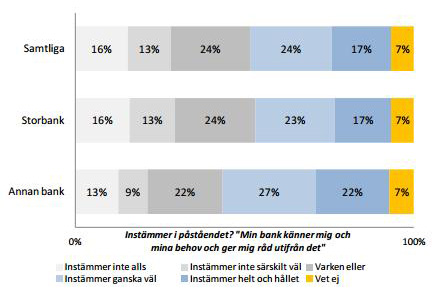
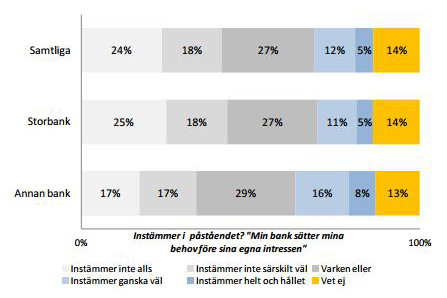
In Sweden, Länsförsäkringar recently performed a study asking 3,500 customers about their views of the banking today. A major finding was the perception that banks are putting their own interest over the ones of the customer. Only 4 out of 10 respondents felt that their bank knew them and provided advice based on that knowledge. In summary – the banks are still considered to be big, impersonal and greedy.

crop 5

crop 6

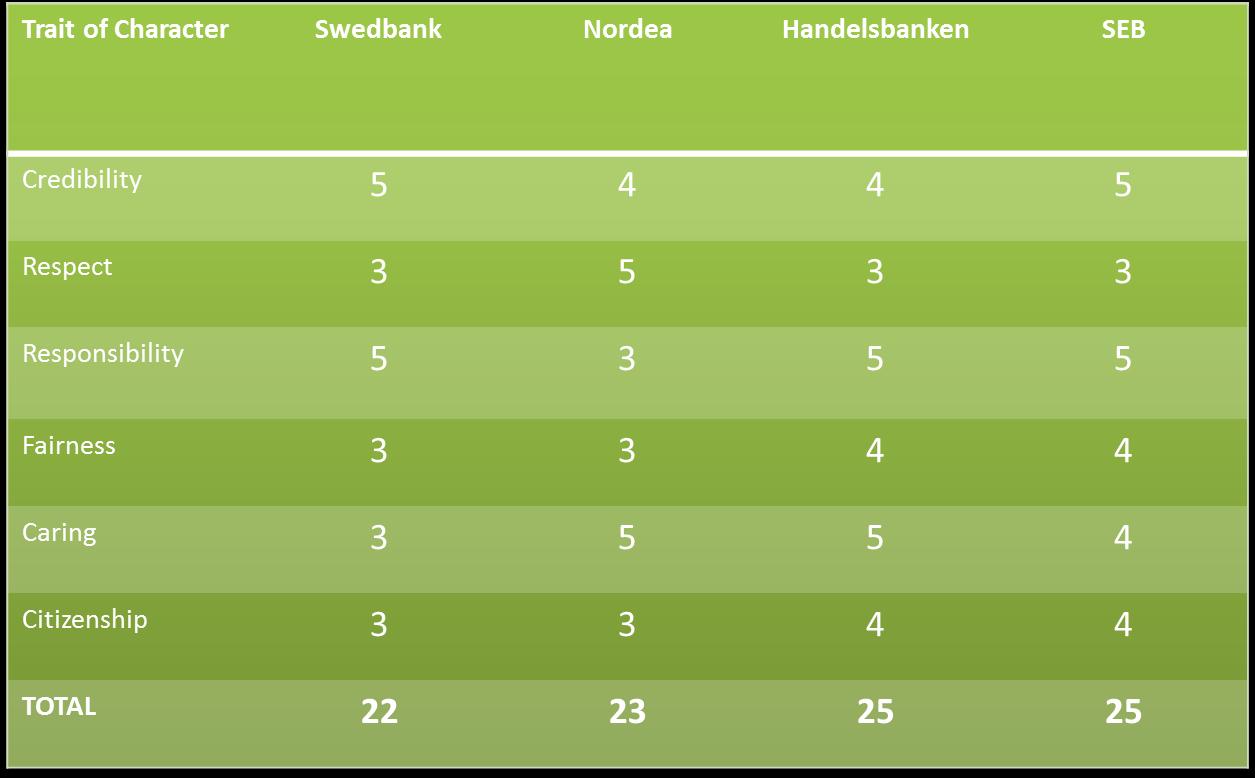
You could also look at banks as you would at a guest at your dinner table. For a study last year,  salesforce.com took a closer look at the “personality” of banks together with Psykologilabbet, a psychology practice in the forefront of psychology research. The study was based on the how banks are choosing to describe themselves, but more importantly how they are being perceived by the outside world (via media, blogs, forums etc.)  Psykologilabbet studied banks in the same way they would an individual – ranking them according to some key criteria that in total makes up a strong character (and a pleasant dinner guest) – credibility, respect, responsibility, fairness, caring and citizenship. This study showed that although the Swedish large banks are perceived as relatively credible, they overall score low in traits such as respect, fairness and citizenship.

bild3

All this, combined with the ease of customer taking their business elsewhere should make some of these institutions rethink. The banks paving the way and getting on board with the personalised, value adding approach will have a better shot at winning the race.

In Australia, the Commonwealth Bank, has managed to stick out in the fierce competition through understanding that the relationship with your customers need to be based on getting back to basics – engaging in conversations that bring value to your client. Going back to my butcher example – “I have just the right piece of strip steak for you, and if you like to get it perfect medium rare leave it alone for 9 minutes on one side and 7 on the other”.


Direct link: http://www.youtube.com/watch?v=A98NFBm8b9U

Commonwealth Bank understands that the client´s financial world really isn´t hapenning inside the bank office: It´s when you are out and about and see a house you´d like to buy, or when drafting your exciting business plan and need to quickly grasp your funding opportunities. The personal, financial conversation you would have with your bank contact therefore needs to get extended to that world – without losing the value factor.

And this is where social comes in

By running the business on a platform allowing for collaboration, the services provided become relevant to every customer. You see a house you like? Take a picture, the bank compiles the information needed, and the loan gets approved while on site.

However you´d like to package your offering, your approach needs to be based on the love for and knowledge of your customer. Same rules of relationship apply whether you are a small shop or a large corporation. So, you need to ask yourself “Do I give a damn?”

Share and Grow – sincere, open, likeable Swedish innovators – you will be sorry you missed it

Conferences, seminars, trade shows, events – the hype this spring are Social Media events. Most of these are focused on understanding social and what it can do for business, still making the point that it really is good for business. But it is – so why do we keep arguing that point?

There is the travelling road show of SMW – Social Media Week which hit the Nordics last week – and then there is SSMX.

SSMX grupp

It’s different. It’s owned by the delegates and it’s as flexible and unpredictable as a friendly amoebae – constantly evolving. These people – and the rest of us – are here growing as a professional, growing our business, growing our influence by sharing what we do with others. Very social.

Sincere – Open – Collaborative – Interested – Authentic – Likeable

Sessions vary from a heavy focus on technical innovation to practical examples to workshops where we sit in a circle and discuss and challenge each other. All sessions are initiated and run by the delegates themselves. Many of them filmed on the spot to share with those not there – take a look at some of them, you will be inspired.

http://video.ssmx.se/

Disruptive Leadership

It’s a myth that the social innovator scene is dominated by young geeks and nerds. I attended a session at SSMX with @johanlange who wrote the book LUCKc taking lean one step further. Once again, one session evolves into a continued exchange, and I will now attend his follow up breakfast sessions in Stockholm discussing out of the box leadership.

Changing the outcome – through Twitter

It’s a myth that social enthusiasts are techies only. I attended a session with @johansbuzz showing just how significant the social presence is in times of crisis by example of the labour union’s perspective of the negotiations with the employees last fall that led to the agreement that kept Scandinavian Airlines flying – at a time where the ultimate worst case was bankruptcy. If you understand Swedish, there is a recording of the session

http://unionenopinion.se/2013/02/unionen-delade-med-sig-pa-ssmx/

Social Customer Service – #UnitedBreaksGuitars

We had an interactive session discussing social customer service by example of airlines. 40 people in the room contacted airlines via three different channels

  1. Twitter
  2. Facebook
  3. Contact Me Forms – Email

Before the session Datasift.com  had analysed 100,000 tweets to/from 33 different airlines to check how responsive they were.

The same winner emerged during the experiment: it took KLM 28 minutes to respond with a qualified/useful answer to the Facebook post. (More on this study and results/experiment in an upcoming blog. Lots of data to analyse.)

What is SSMX – and these unconferences – and how to fertilize innovation?

Try googling SSMX or look it up on Twitter #SSMX (once you learn to ignore a less favourable ongoing Twitter conversation in Japan which had a completely different, and definitely not business facing use of the tag).

Karin Bäcklund SSMX 2013

People share pictures – don’t we all. Here are some nice ones that are truly artistic by @deeped

But they share content, reflections, discussions, presentations, feedback, research and already now feel inspired thinking about how to contribute to the next major sharing event in this community. There are similar unconferences happening across the Nordics, as an example the WebCoast

https://www.facebook.com/webcoast

… in Gothenburg taking the conference out into the region.

Sweden is a big  country with long distances to travel, and not everything happens in Stockholm. Another not to be missed social innovation event is happening over a weekend on an island off the southeast coast called Tjärö. Bring your tent, and beware of the sheep

Hem

sswc-lounge.jpg

The most innovative countries in the world. Come see us.

Iceland, Sweden, Norway, Finland (and Australia and Canada) had the highest internet penetration/usage per capita in the world back in the early 1990s when it all took off. At the time I was a business analyst and spent a lot of effort trying to understand why.

Finally I know:  it’s because it was social.

It’s human nature to want to engage with others, and if you think about the geography and demographics of the above countries, there are a lot of people who are physically isolated from each other and/or the world. If you have to drive 80 km to the nearest library, it makes sense to search for your information online. If you have to drive 80 km to meet up with your peers after work, it makes sense to engage with them on Facebook or Twitter instead. (Especially right now, when there are extreme temperatures (on either end of the scale) in all of the above countries.)

There are many lists of innovative countries provided by various consulting groups and government and independent research groups. There is never a completely unbiased view; it all depends on the metrics. But it is remarkable that all lists, regardless of the research parameters, list the above countries who were Internet early adopters, in the top tier.

What is the Nordics secret sauce of innovation?

Those who say “it cannot be done” are interrupted by somebody already doing it

Sweden – and most Nordic countries – are not necessarily innovation-friendly in terms of startups. But if you are driven by the passion of your idea, and not just by a narrowminded focus on making profit early on, there is a pool of extremely well educated people, the Born Digital Generation, who take nothing for granted, and who just do it. Take a look at the list below to show just a few remarkable Nordics innovation achievements.

Want to be innovation-inspired?

Here’s my suggestion: join the Born Digital Generation in the Nordics on one of these upcoming social media events (listed below). And feel free to ping me @echristensen42 with more events so that the list can be expanded.

Increasingly, these events are not your standard-shelfware of conferences with speakers pitching their products or showcasing their own brilliance. The Born Digital Generation wants to own the discussion and even decide on the agenda through crowdsourcing – or in this case Friendsourcing. These people already know each other – through social media. The events are just a chance to have some facetime.

         
Iceland Reykjavik Internet Marketing Conference http://www.rimc.is/en/ March 21-22 Great lineup of visionary speakers
Sweden SSMX – Sweden Social Media Exchange www.ssmx.se February 22-24 Unconference – agenda is friendsourced
Sweden SSWC – Sweden Social Web Camp http://www.swedensocialwebcamp.com/ August 15 – 18 Unconference – 450 creative minds on an island.
Norway Webforum http://web-forum.no/ March 14-15 Setting the stage for social in Norway
         

And here’s a reminder – a list of Nordic innovators you may or may not know were… Nordic (thanks to @dortetoft and Thomas Madsen-Mygdal for the comprehensive list):

  • Linux was invented by Linus Torvalds (Finland)
  • C++ was created by Bjarne Stoustrup (Denmark)
  • Microsofts C# (C Sharp) and so also the .Net-platform came from Anders Hejlsberg (Denmark)
  • PHP-scripting was created by Rasmus Lerdorf (Denmark)
  • MySQL was invented by a Finn and a Swede (not sure of their names, can anyone help?)
  • Ruby on Rails – we can thank David Heinemeier Hansson (Denmark)
  • Opera was built in Norway and Iceland (not sure of their names, can anyone help?)
  • Linus Torvalds (Finland) gave us GIT
  • The Danish company Umbraco provides the CMS-system on the Microsoft platform ( Niels Hartvig)
  • Skype was invented by a Dane and a Swede (Janus Friis, Niklas Zennström)
  • Oh, and don’t forget Spotify (Sweden), Angry Birds (Rovio-Finland) and Minecraft (Sweden)

More references:

http://bizzen.blogs.business.dk/2013/01/28/it-ivaerksaetter-norden-gor-det-godt-men-for-smat/

http://www.swedishtradehistory.com/Assignments/From-circular-to-the-internet/

http://stakeholders.ofcom.org.uk/market-data-research/market-data/communications-market-reports/cmr12/international/icmr-5.07

http://www.globalinnovationindex.org/gii/main/2012rankings.html

http://www.bloomberg.com/news/2012-07-03/switzerland-sweden-are-world-s-most-innovative-countries.html

http://www.ideaconnection.com/blog/2012/07/highlighting-the-worlds-most-innovative-countries/

http://www.wired.co.uk/topics/wired-european-startups

Good people to follow if you want to be on top of Nordics innovation (feel free to add to list – ping me):

@annika

@hampusbrynolf

@trulytherese